- Exploring Elections
- General Election Results
- Primary Election Results
- Data Downloads
- Lore Store
- Sources
- Use Cases
Overview
Lore provides a lot of information on the 2022 election. Our knowledge of that election forms the foundation of future actions pertaining to the 2024 election. Politics is little different than other activities; our past experience informs future decision making.
The information provided by Lore does not change. These are the facts surrounding the 2022 election. Our interpretation of those facts, however, can change. Lore is designed to let the facts (data) speak for themselves not interpret those facts. But Lore is not a clinical depiction of a political landscape. It is a portrait of a people and the millions of decisions they made in 2022 but seen from a distance. It is much more like a Monet than a spreadsheet.
If you fail to see it that way, then you will also fail to see the people behind these numbers, which in my opinion leads to flawed and callous thinking. In particular, it leads one to confuse past decisions that are immutable with future decisions that have yet to be made. Voters, candidates, and parties influence those making the decisions. If one want’s a different decision, then one needs to offer at a minimum a different, compelling vision of the future.
Although I want to leave the interpretation of the facts to the you, I have chosen to organize the presentation of those facts in a manner that illustrates the influence of age and race on past decision making. There is an assumption underpinning Lore that different candidates and different candidate priorities will ultimately result in different decisions. The status quo is maintained not by demographics, but by candidates and parties choosing to do the same thing year after year.
Basics
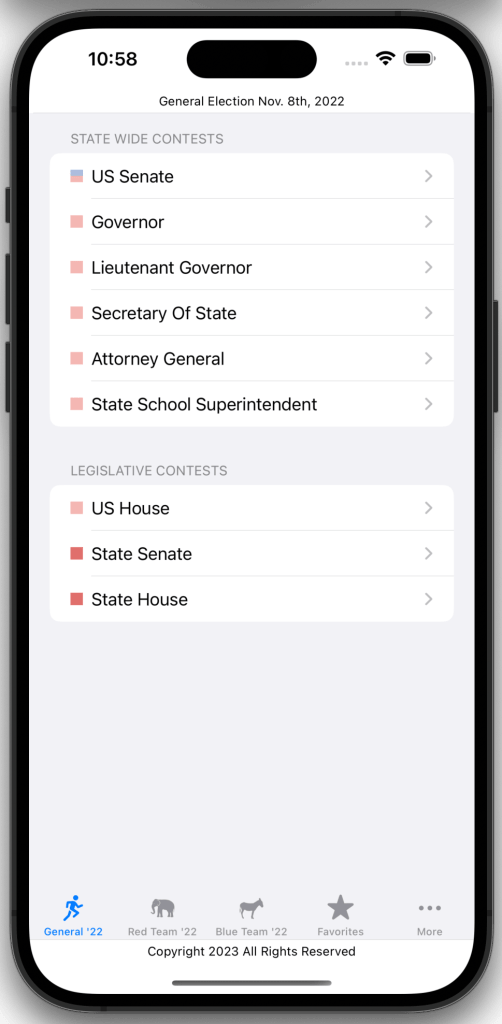
The Lore Home Screen has five tabs:
- 2022 General election contests, indicated by a runner
- 2022 Republican primary contests, indicated by an elephant
- 2022 Democratic primary contests, indicated by a donkey
- Favorites, indicated by a star
- Less frequently used actions, indicated by ellipsis
Note that the Republican Party is referred to as the Red Team and the Democratic Party is referred to as the Blue Team.
Contests are organized into three sections:
- Favorites (if there are no favorites, this section will be missing
- Statewide office contest
- Legislative contests
Just tap a contest to begin exploring.
Navigation
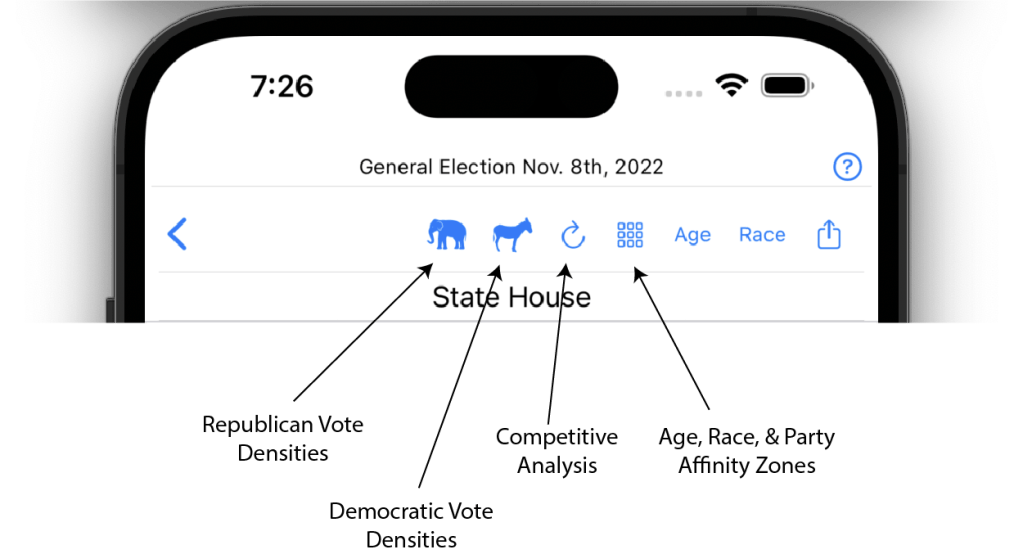
From a map you can navigate to other maps and visualizations:
- A map of Republican vote densities, bright yellow has the highest density, dark blue has the lowest density
- A map of Democratic vote densities, bright yellow has the highest density, dark blue has the lowest density
- Competitive analysis of legislative districts (only available on state level maps for legislative districts, i.e., US House, State Senate, State House)
- Age, Race, and Party affinity zones
- Turnout by age group
- Turnout by race
Less Frequent Actions
There are four less frequently accessed actions:
- Purchase subscriptions in the Lore Store
- View the data sources
- View Terms of Service
- Reseting the cache
Reseting the cache can be required under rare circumstances. The data that underpins the app is maintained in the cloud. The typical user does not require all the data available. When a you need data for a particular task, if that data is not currently locally stored on your device, it will be downloaded from the cloud and cached. If that caching process is interrupted by a lack of space on your device or your battery dying, for example, your download may be incomplete. An incomplete download could result in crashes or inaccurate results. If something like this should happen, you can reset the cache and caching, when required, will begin with the device in a pristine state. Alternatively, you can reinstall the app.
Detail Level
The base app provides information at the State, County, and District level. If you need or want information at the precinct level, you will need to purchase a subscription from the Lore Store.
 Election Lore