The United States should focus its economic strategy on education, not broad-based tariffs aimed at job creation.
While tariffs may offer short-term political appeal, they are a blunt instrument that misunderstands the realities of the global economy. Many of the jobs lost to globalization were labor-intensive roles that either became automated or shifted offshore to lower-wage markets where cost advantages were significant.
Broad tariffs might succeed in bringing some jobs back — but to what end? They would primarily return low-wage, labor-intensive work to an economy that is already near full employment, and where the real challenge is preparing workers for the jobs of the future, not reviving those of the past.
Instead, real growth is occurring in the knowledge economy, where success depends not on low labor costs but on skills, creativity, adaptability — and the ability to learn, apply, and grow across a wide range of work, from technical trades to advanced professions. That shift makes lifelong learning essential. Lifelong learning, however, is a shared endeavor — because we all have a stake in its success. It places new demands not only on workers, but also on employers and the nation as a whole.
Individuals must contribute time, effort, and initiative to learning throughout their lives — whether that learning happens in classrooms, on shop floors, behind the wheel, or through direct service to others. Employers must not only invest in their employees, but also recognize the value of identifying and developing potential — rather than leaving that entirely to schools, certifications, or outside institutions. Policy must focus on access, quality, and affordability. Individuals invest in themselves and their future. Employers, in turn, benefit from that investment and should treat it as an asset to be cultivated, not merely consumed.
This paradigm only works when the public sector ensures that opportunity is real — that systems are in place to support aspiration with structure, access, and meaningful pathways.
The state’s involvement in post-secondary education is not only justified — it is essential.
First, the state has a compelling interest in the outcome. A skilled, adaptable workforce is the foundation of national competitiveness, innovation, social mobility, and security. In an economy increasingly driven by knowledge and technology, broad access to high-quality education is not a private luxury — it is a public necessity.
Second, the state has contributed to the current crisis in affordability. Over the past several decades, the cost of a post-secondary public education has grown explosively — far faster than inflation, wages, or most household incomes.
The chart below illustrates this clearly: while wages have grown steadily, college tuition and fees have skyrocketed, nearly doubling the rate of wage growth since the mid-1980s.
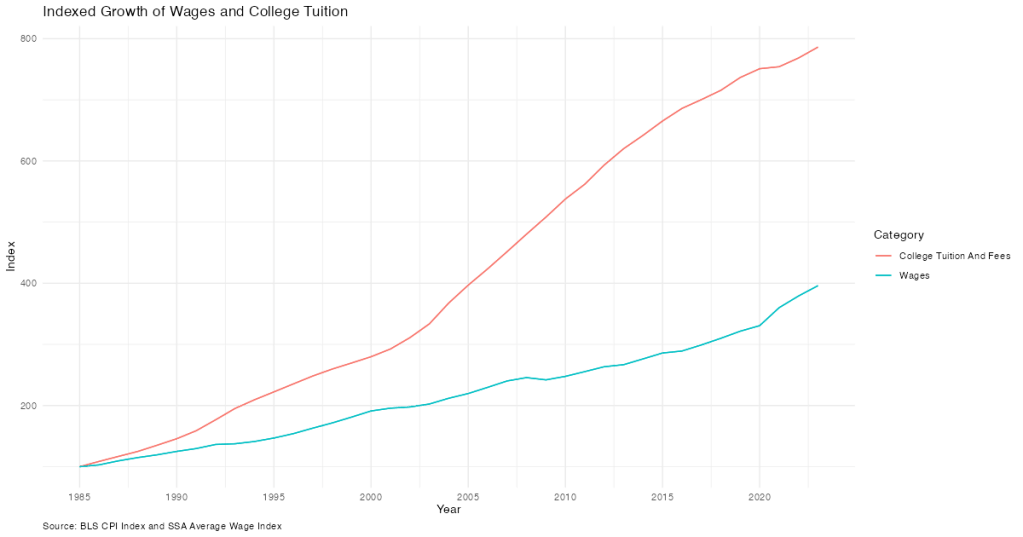
Rising tuition, fees, and the expanding costs of campus operations have outpaced the ability of students and families to pay. Public policy has often responded with debt-based solutions rather than meaningful cost control. If individuals are now expected to invest in themselves, it is only fair — and strategically necessary — for the public sector to ensure that doing so is both possible and worthwhile.
These are challenges that must be addressed at both the national and state level.
While federal policy shapes the broader economic strategy, public colleges and universities are run by the states. Much of the responsibility for cost and access lies in state policy and governance.
Yes, reductions in public funding played a role. But that alone doesn’t explain the explosive growth in costs.
The reality is that education must become less expensive — not just for students, but for the state itself.
We cannot afford to solve this problem simply by raising taxes or throwing more money at a broken system.
What we need is a serious effort to redesign how we prepare people for work — not just through higher education, but through every system that helps people build practical skills, from technical training to service jobs to lifelong learning.
Affordability isn’t just about who pays.
It’s about what we’re paying for — and whether it still delivers on its promise.
 Election Lore
Leave a comment