Understanding the intricacies of split ticket voting in Georgia’s legislative districts is paramount for crafting effective state party strategies. This phenomenon reflects a diverse electorate willing to transcend party lines based on candidate qualities, policy stances, and local concerns. Such insights are indispensable for parties seeking to navigate the political landscape of the state.
The presence of split tickets underscores the complexity of Georgia’s political scene, where voters prioritize individual candidates and issues over strict party allegiance. This signals a need for parties to adopt flexible and nuanced approaches, engaging with constituents on a more personalized level. Additionally, it emphasizes the importance of candidate appeal, targeted messaging, and a willingness to collaborate across party lines.
Identifying swing seats and assessing seats at risk is critical for strategic campaign planning. By analyzing split ticket data, parties can pinpoint districts where support may be up for grabs or incumbents are vulnerable. This allows for the allocation of resources to key battlegrounds, ensuring maximum impact in competitive races.
Building a state party strategy based on a comprehensive analysis of split tickets involves several key steps. Parties must first gather and analyze data on voting patterns within each legislative district. Next, they should identify trends and patterns, recognizing where opportunities for electoral gains exist. Finally, parties can develop tailored campaign strategies that resonate with the unique demographics and political inclinations of each district, maximizing their chances of success.
Lore simplifies the process of data collection and analysis for political parties by providing comprehensive insights into voting patterns within each legislative district in Georgia (14 US House, 56 State Senate, and 180 State House Districts). Through its user-friendly interface and powerful analytics tools, parties can effortlessly identify trends and patterns, enabling them to pinpoint areas of opportunity for electoral gains. By leveraging the detailed data provided by the Lore, parties can make informed decisions about resource allocation and campaign strategy, ensuring they effectively target their efforts where they are most likely to yield results.
For example, to obtain a state level competitive analysis for the Georgia State House, tap on Profiles and then party specific point of view for the general election (i.e., 2022 mid-terms).
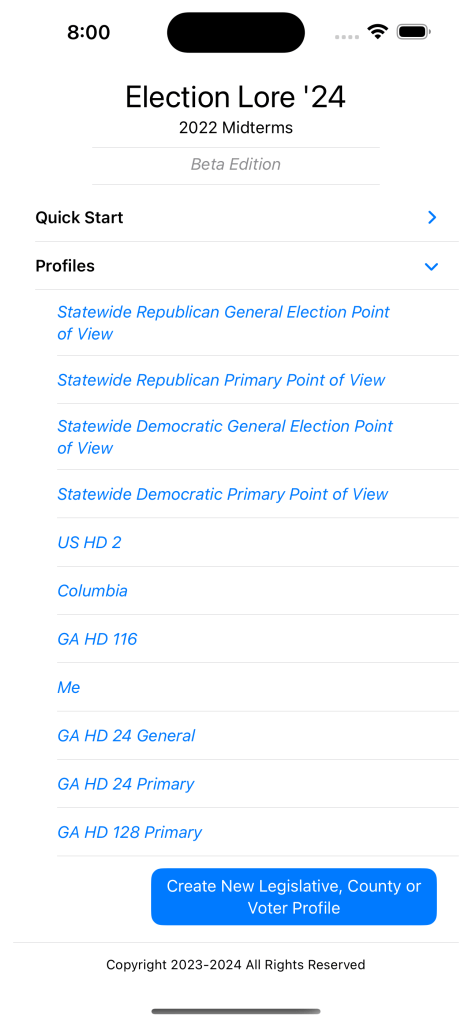
Next tap the drop down menu button (upper left in the red(blue) header). Then tap on the State House Caucus drop down. Lastly, tap the State House District Competitive Analysis button.
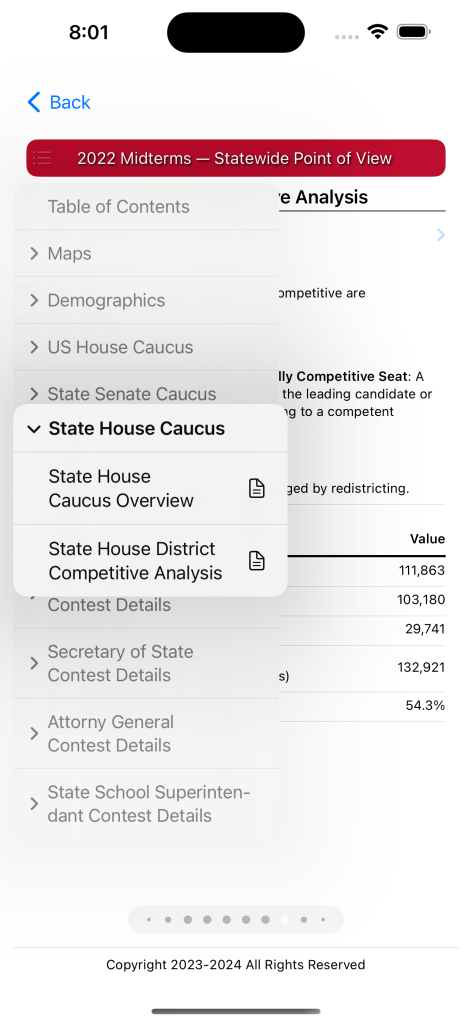
The State House District Competitive Analysis list shows only those districts that are somewhat competitive. Party strongholds are excluded. The screenshot below shows the competitive analysis for the 99th State House District. This seat, currently held by the Republican Party, is identified as marginally competitive. The voter base for each party is very nearly equal. The outcome is determined almost entirely by split ballot voters.
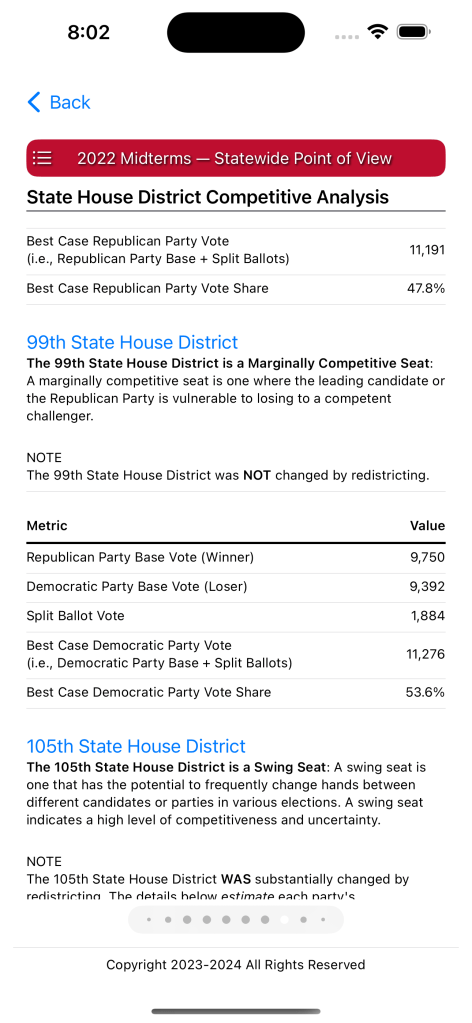
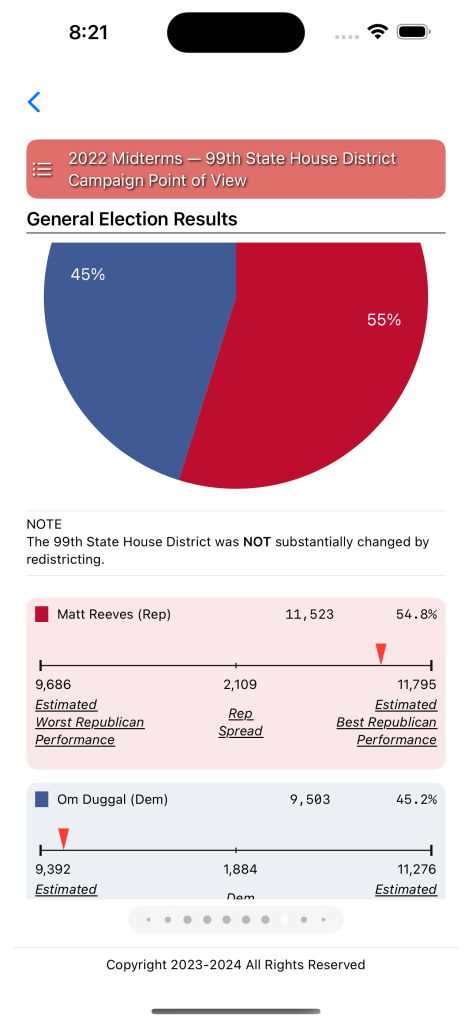
You can dig a little deeper by tapping on the blue 99th State House District link. Here you find that Matt Reeves polled exceptionally well in his party; whereas, the Democratic challenger performed poorly. The conclusion is that Representative Reeves is a strong candidate but might be unseated by a particularly compelling Democratic candidate.
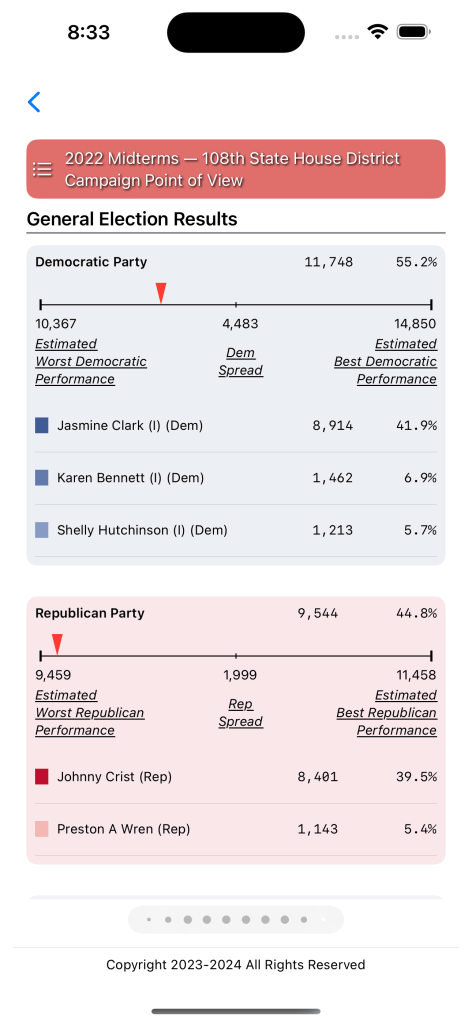
In the 108th, like the 99th, split ballot voters were largely responsible for the outcome of the race but the election results tell a different story.
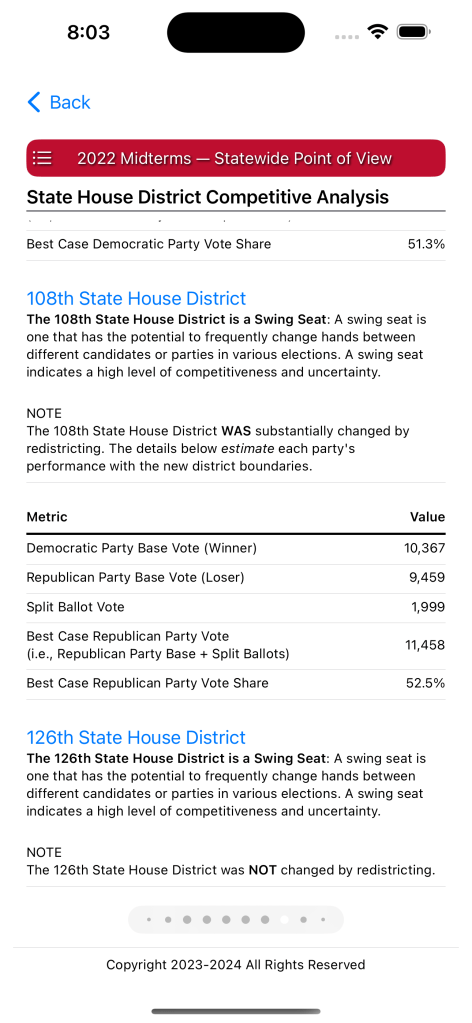
The 108th was substantially changed by redistricting. In the new district neither party polls particularly well, but the Republican Party polled particularly poorly. Moreover, the undervote was 4.7% of the total ballots cast. In comparison, the undervote in the 99th was a little over 1%. What this suggests is that the voters in the new 108th were not particularly impressed by either party’s candidates. This situation sounds like an opportunity for someone.
In conclusion, understanding and leveraging split ticket analysis is essential for state parties in Georgia to navigate the complexities of the political landscape successfully. By embracing voter diversity, identifying strategic opportunities, and tailoring campaigns accordingly, parties can position themselves for electoral success and shape the future of state politics.
The key point is that Lore does most of the heavy lifting for you. You don’t have to do all the analysis yourself. You do have to accept, however, that in some races party brand is not enough to carry a candidate. Sometimes the message and the candidate are more decidedly relevant than the party.
 Election Lore
Leave a comment