There are a lot of good reasons to run for legislative office, but the weight of those reasons has to be sufficient to outweigh the effort and difficulties inherent in running for public office. Ultimately, the challenge will be proportional to the competitiveness of the race. Lore will give you a lot of insight into the competitiveness of a particular race.
To illustrate how to use Lore to inform your decision of whether or not to run you will create two profiles. A profile uses a few details about what you want to do to construct a point of view on the 2022 election. This point of view presents the information that is most relevant to the decisions you will need to make.
Start by opening the Lore App. You will see the following screen. Tap Profiles.

There are for standard profiles that provide high level view of the state electoral landscape. You, however, will create two profiles that focus in on two state house legislative races. To create your first profile, tap the blue Create New Legislative, County, or Voter Profile button.
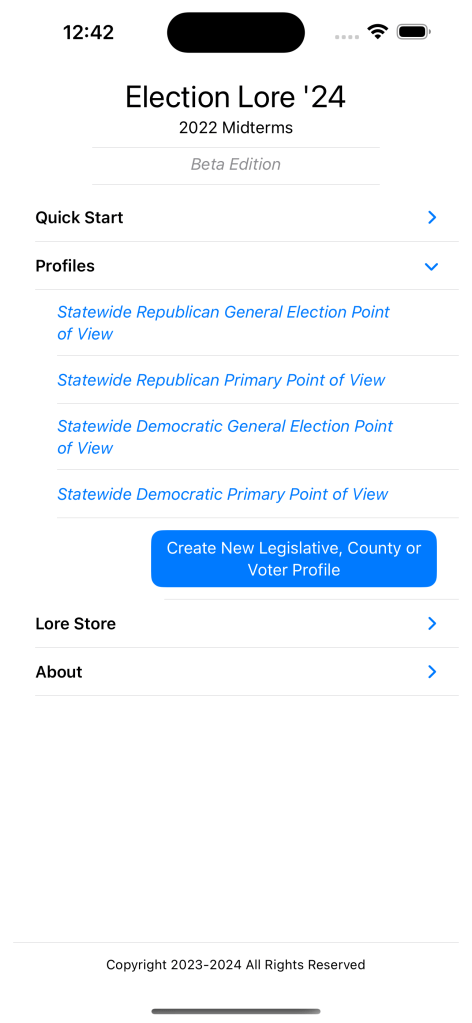
The first profile you will create will be for State House District 131. You will choose the Legislative Campaign role.
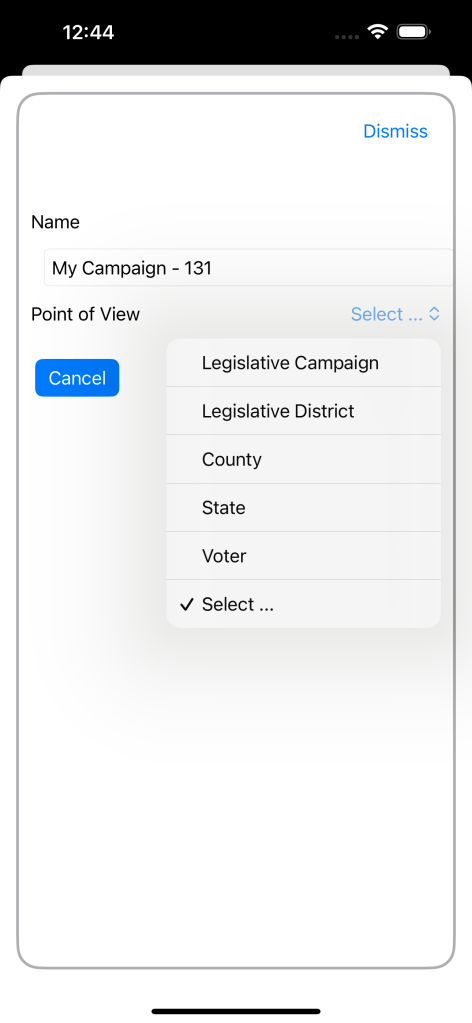
Next fill in the other details. It’s a State House contest. Select the Republican Party for this example. Select the General as the election type. Lastly, enter 131 as the district. Tap the blue Save button to save the profile.
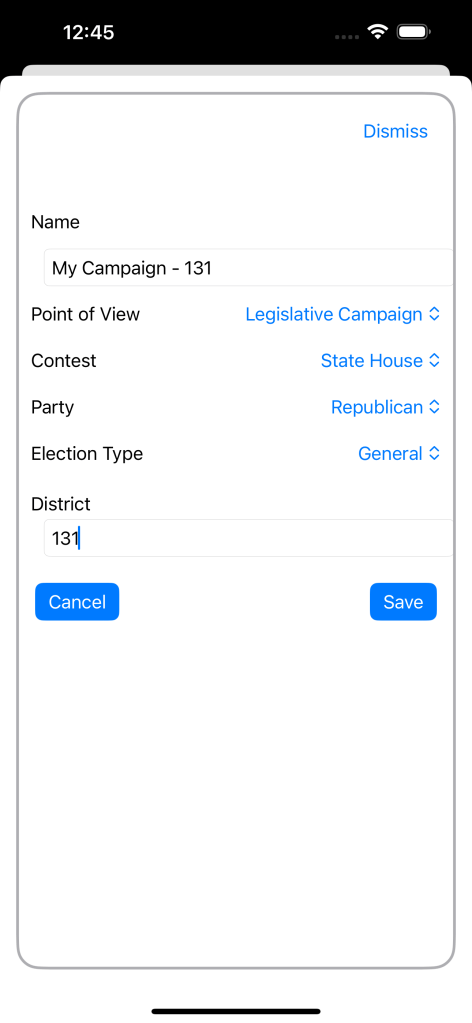
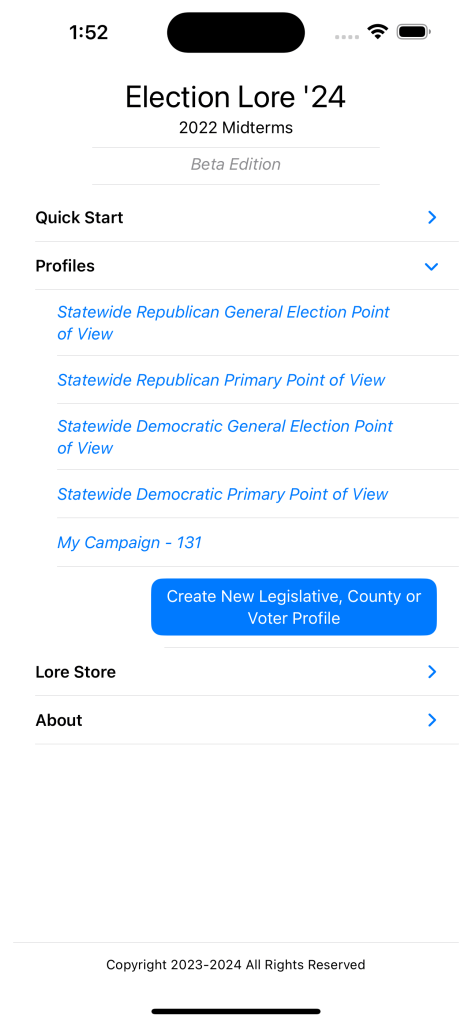
You now have a profile for a legislative campaign for a State House district running as a Republican (the app is non-partisan; the next example will be for a Democratic candidate). Tap the blue My Campaign – 131 button.
Your point of view is organized as a report with a number of pages. There are 3 top level sections: a Notes section, details on the election results, and details on the demographics of the district. The Notes section contains some short discussions about various topics on Lore and elections. Tap on the131st State House District Contest button.
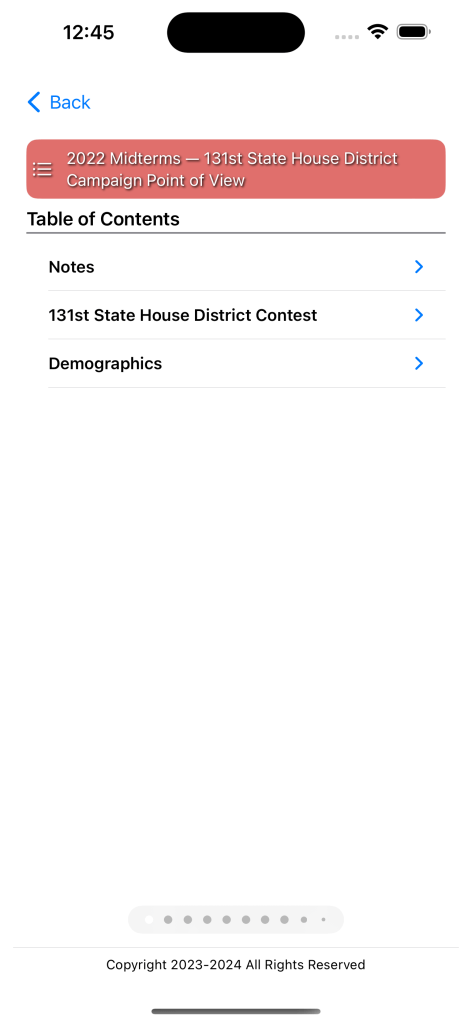
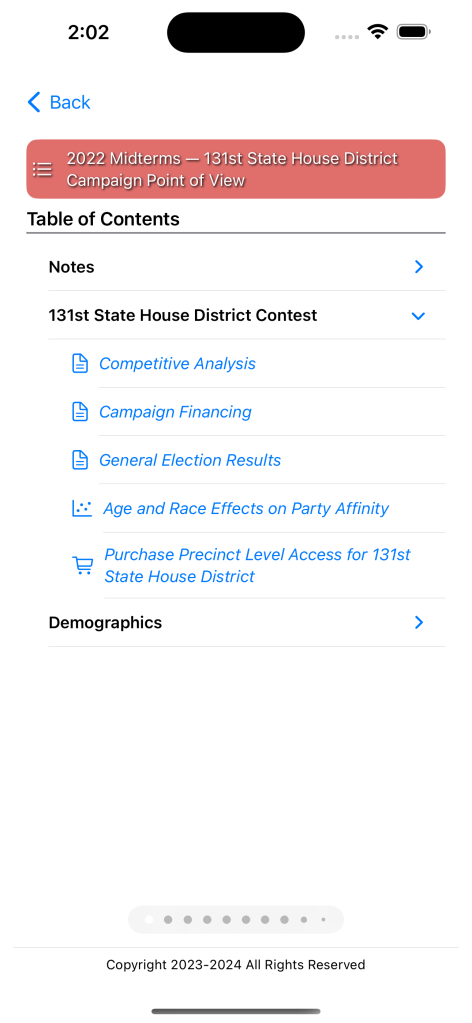
Lore describes election results from several different perspectives, the first of which concerns the competitiveness of the race. Tap on the blue Competitive Analysis button.
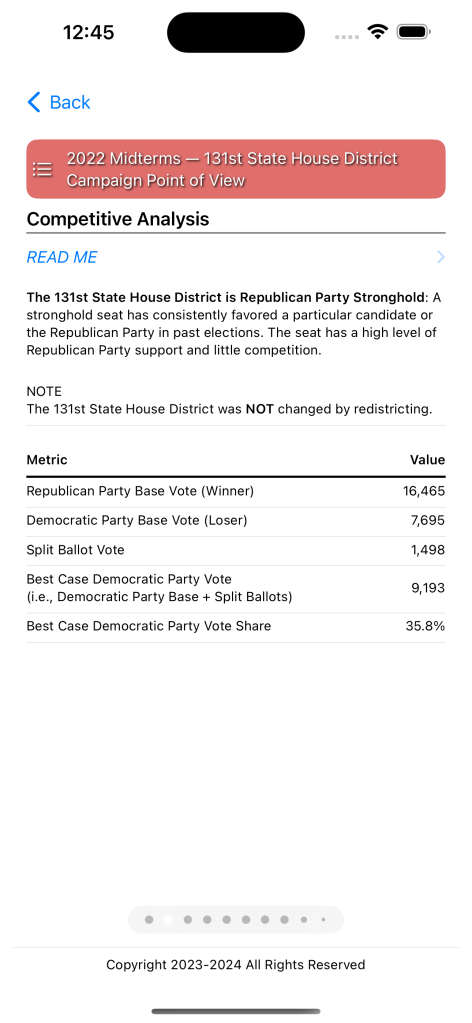
In order to build a competitive analysis for a district, Lore digs into the details of split ballots (i.e., where a voter casts a ballot in a general election for candidates of more than one party). Consider Walker’s run for the Senate. Walker amassed 200,000 fewer votes than Governor Kemp. So some of the folks that voted for Governor Kemp voted for Senator Warnock, some voted for the Libertarian candidate, and some didn’t cast a vote for Senator. The point is there is a spread between the best and worst performing candidates in the party at the precinct level. The spread is made up of voters who decide mostly who to vote for based on the candidate not the party. Using the spread to your advantage, however, means you have to be a compelling candidate. The party brand sway the voters in the spread.
From this insight, Lore estimates the best that a candidate of losing party can do in this district. Lore focuses on the losing party because the most interesting question is whether the seat could flip in the next election cycle. An incumbent would like to know how hard they will need to work to retain their seat. Whereas a challenger will want to know how hard they will need to work to gain the seat.
The key detail you will want to look at is the competitiveness assessment. In this case, the assessment states that the district is a Republican Party Stronghold. What that means is the Republican candidate is likely unopposed in the general election. If the candidate is opposed in the general election, they will win by a large majority. In short, if you win the primary, you will win the general election. The take away is that if you are a Republican, your entire effort will focus on winning the primary. If you want to run as the Democratic Party candidate, then you think of other reasons to do so besides winning, like: gain campaigning experience, educating yourself and voters, or making a point. Part 2 of this series will look at a district that is competitive in the general election.
 Election Lore
Leave a comment